Monday, December 17, 2012

The Holidays


                                              The Holidays

People throughout the world are celebrating holidays this month, including Chanukah this past week and Christmas next week.  The spending frenzy that supports the practice of gift giving for these two holidays is often excessive and might obscure the stories upon which these holidays are based.  But don’t worry – I’m not advocating Scrooge-like behavior here.

The thoughtfulness associated with gift giving is a good thing, and letting those you love know that you care about them is both important and fun.  Seeing the joy on recipients’ faces when they get presents warms everyone’s hearts and hopefully makes them curious about the specialness of the occasion.  That’s why it’s important at that moment to tell the story behind why we celebrate.

These stories are mostly from the long-ago past and they beg to be told, and it’s a disservice to young and old alike to give the gift without telling the tale.  This is how societies endure, how histories persist, and how new generations learn from the old.  Storytelling is as old as mankind and serves as the basis for all that we know and cherish.  And even with the advent of the Internet and the ability to search for the meaning of anything, without the human voice behind the facts there is no humanity in the learning.

So give all the gifts you want, but remember the best gift of all is the understanding of what things are, and how they got to be what they are.  While it certainly is the thought that counts, it’s truly the meaning that endures.  Happy Holidays to all, and to all a good night!

My message this week is about being responsible for what goes on around us:

“The price of greatness is responsibility.”  Winston Churchill

What price would you be willing to pay for success or greatness, or even just making things right?  You’d probably be willing to put in lots of hard work, and you’d most likely care a lot, and you might even give up your free time.  You also might consider putting in some money. But after all of that, it’s the commitment and responsibility that you put into the work that you do or the things that you give that will ratchet them up to the level of being special or even achieving greatness.  Lots of people give everything they have to give and still don’t make it to that higher level – that’s because they did not put in all of their heart and soul and inspiration and passion – basically they didn’t accept full ownership and responsibility for their actions.  So if you want greatness, the price is full responsibility.  Nothing more; nothing less.

Sir Winston Leonard Spencer-Churchill (1874 – 1965), was a British politician, best known for his leadership of the United Kingdom during the Second World War.  His funeral was the largest state funeral in world history, with representatives from 112 nations.

Stay well!      
                                                                                        
PS: many of you asked about last week’s blog and whether I was leaving NYC – the answer is “no, we are keeping our Brooklyn apartment while I continue to work and consult there”.  The only difference is that now our home base will be in Las Vegas instead of Laguna Beach.  Thanks for asking.  


Monday, December 10, 2012

A Change of View


                         A Change of View

For the past 6 years we’ve lived in Laguna Beach, an idyllic arts’ community in Southern California.  It was like a dream come true: living in the canyon, smelling the sea in the air, walking the beaches and enjoying the best climate anywhere. Eclectic friends, the sound of the surf, and sunsets over the ocean all made living there very special.

But dreams, and views, change.  The desire to be closer to family slowly eroded the dream and so we sold our house in the treetops of Bluebird Canyon this past week and are moving back to Las Vegas.  The perfect weather, the sounds and sights and smells of the ocean, the friends we made there are now joining the memories of other past homes and communities.  We thought we were going to stay there forever; but forever is a very long time. 

Six years wasn’t forever, but it was more than enough time to again accumulate stuff that seemed superfluous when packing to move.  Boxes that were filled one or more moves previously – do we really need that stuff?  Drawers filled with this and that trinket that we just had to save – for what?  Ok – the 300 record albums – can’t get rid of those……but not much stuff has memories like those old friends. And into the truck it all went for storage until we find our next home.

And as we head across the desert back to Las Vegas we can’t help but reflect on the fact that it’s not the stuff we collect but rather the families we have that are our most important and cherished possessions.  We’ve lived in many places, but the place that we’re now drawn to the most is where our family is; and it’s the place we want to be.  It doesn’t come with an ocean or beach, but a day with family beats those every day.  Watching a sunset over the ocean is cool, but watching our granddaughter grow is immeasurably cooler. Change for this is good; changing our view about what’s really important: priceless.

My message this week is about getting the most out of life:

“It’s not what happens to you that determines how far you will go in life; it is how you handle what happens to you.” Zig Ziglar

Attitude has a lot to do with loyalty: as in the attitudes of those your work with, and your attitude about where you work and with whom. If you don’t like the people you work with, and how they treat you, then it’s hard to be loyal to them and your company.  I’m not saying you have to love everyone, but there has to be mutual trust and respect, and good and open communications, and everyone should treat others the way they want to be treated. Those are the kinds of things that foster good attitudes, and help build and maintain loyalty. It won’t always be perfect, but if everyone is committed to these then your attitude and theirs will help build these relationships.  And when things happen that might negatively affect those relationships, it’s not what happened as much as how you and your colleagues handle what happens.  Be mindful of others’ needs and feelings, and they will most likely give you the same courtesy.   And that will help build loyalty, today and every day.

Stay well!

Sunday, December 2, 2012

What's In a Name


                       What’s In A Name

Last week was all about thanksgiving, and hopefully much of that remains this week and beyond.  Like many of you I spent the holiday with family and found that more nourishing than the food on the table.  But there was more.

My granddaughter is now at an age where she can receive a formal Hebrew name.  Because there’s no Hebrew equivalent for Olive, her parents had a choice, and with the Rabbi decided on a derivative of Shalom, the Hebrew word for Peace.

Normally, parents take their child to a synagogue to be named on a day when the Torah is read, but my daughter and her husband decided to invite the Rabbi to come perform the ceremony at their house before Thanksgiving dinner: with all the family around and with thankfulness already in the air.

The ritual, up close and personal as it was, was shared by all. Everyone there got to participate in the ceremony in front of the others, and this sense of sharing made it so much more meaningful. We often don’t really have a sense of where a name comes from, or what it means, or how it might actually signify something about the person who will have it forever.  

Because the relatives there were part of the ceremony, each will now have a stronger bond to Olive, or Shlomayte (her Hebrew name). The blessings were more meaningful, the giving of the name was special, and the feeling of thanksgiving for all that we have and share more intense.

Sometimes we assign nicknames to others because we have no connection to the name they’ve been given. But when you know where the name really comes from there’s no need to add anything further.  That’s when a name is more than just a name.  And for that I am very thankful.

My message this week is about doing good things for others:

“Power is the ability to do good things for others.” Brooke Astor

Roberta Brooke Astor (1902 – 2007) was an American philanthropist, socialite and writer who was the chairwoman of the Vincent Astor Foundation. She is the author of two novels and two volumes of personal memoirs.

Do you have this kind of power? You probably can, and often do, perform good things for others…but is it a regular thing? People with special skills share those with others to help when needed, those with special knowledge apply that when appropriate, a gift of humor can often ease tensions, and of course money is always helpful. But there are other intangible things that do good things for others: a willing attitude, a strong back, a kind nature, and a keen eye – these can all be helpful in a moment of need.  And in the service business, the greatest powers include a sense of responsibility, an awareness of a need before it’s spoken, and a genuine interest to be helpful even when interrupted.  All of these powers have the potential to do good things for others, and each speaks volumes about you, your commitment, and your integrity.  Use these kinds of powers with others today and see what good they can do!

Stay well!  

Friday, November 16, 2012

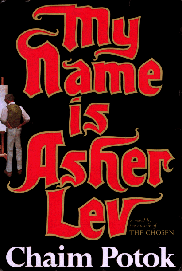
My Name is Asher Lev


My Name is Asher Lev

I enjoy reading novels and when I find an author I like I try to read all of their works.  Chaim Potok is one of my favorite authors and he wrote several books, one of which was My Name is Asher Lev. I read this and his other works many years ago, and these left a lasting impression on me.  Books have a way of doing that.

One of the neat things about living in NYC is the diversity of cultural things to do, and the live theater here is great. So when we saw that an adaptation of this book was playing at an off-Broadway theater, we got tickets and went to see it. 

It’s set in post-war Brooklyn and tells the story of a boy prodigy who must be a painter at any cost – against the will of his family, community and tradition.  It is a moving portrait of a young artist with a universal theme about following one’s passion. 

Following one’s passions was a fairly common theme for many in my generation, and the breadth of new and exciting opportunities presented to us seemed endless.  Art, music, science, technology, social mores, drugs – all of these cascaded around us with such intensity and attractiveness – it was a wonder than the culture of our parents survived. That’s what this play was about.

And now that we have kids and grandchildren, most of whom are facing similar challenges, it doesn’t seem all that intense or passionate.  Is that what now being of an age that once seemed so distant does to us?  Are our passions subdued, or have our experiences moderated those passions? I don’t know the answers to those questions, but I do know that the play was excellent, the acting was inspired, and the story was as moving as ever. 

Maybe a good story is what it’s really all about.  Maybe a provocative theme is forever inspiring.  And maybe lessons learned once carry on throughout our lives.  A good book, like great acting, has the ability to teach us lessons that serve us well. And lessons, at any age, are a wonderful thing!

One of my messages this week was about the joy of becoming who you are:

“The secret of happiness lies in the ancient saying: "Become what you are"  Alan Watts

What’s the secret of happiness?  Some will say it’s the love of their life, others that it’s their car; some will say it’s good health, others claim it to be good fortune; still others will say it’s fulfilling their career ambitions, others will say it’s their retirement; and then there are those who will say they’re happy no matter what.  In truth, to be truly happy one has to be in the full realization of who and what they are, to be doing the things that make them feel fulfilled, to feel that what they’re doing makes a difference, and to know that they’ve left nothing undone.  All of these have the potential to add to your happiness, and together these can form the basis for doing great things.  Because only by becoming what you are can you fully achieve the breadth and scope of your capabilities.  Do that and you’ll find happiness and greatness today!

Stay well!

Friday, November 9, 2012

Who Won?


Who Won?
It was quite an election this past week: lots of winners and losers, lots of after-the-fact analyses about why some won and some lost, and lots of polling about what the majority of the people who voted really want. Everybody seems to have an opinion, but nobody seems to be listening.
We elect people to lead us – how come they don’t?  We try to make sense out of all the noise – but the noisemakers are not making sense.  There are lots of assertions – but not a lot of truth. The only thing that everyone seems to agree on is that the partisan bickering has to stop, and nobody believes that it will.

The guy who lost gave a concession speech that made us want to give him another chance – but it was too little, too late.  The guy who won sounded reasonably conciliatory and magnanimous – but will ideology or commonsense prevail?

Politics, like life, is all about the give and take required to keep moving forward. We elect people to figure out solutions to the problems we face but unfortunately, after they get elected, our representatives tend to then make speeches rather than decisions.  And that’s no way to solve problems and move the country forward.

So, who won? If the people we elected, and those who lost, stop bickering and start working together, then we’ll all have won. But if they revert back to the same old partisan and ideological grandstanding, then everyone will have lost.  It should not be about party ideology as much as it should be about honesty, leadership, and working together to address and solve our real problems.  If they realize that – we win; if they don’t – we lose.

Now is the time for serious leadership, not ideological partisanship.  If our elected officials and the parties they’re affiliated with don’t get that then there will be no winners.  Let your elected officials know how you feel if you really want to be a winner in these elections!

One of my messages this week was about working together and winning as a team, and it seems appropriate in light of this week’s events:

“To find a fault is easy; to do better may be difficult.”  Plutarch
What kind of team player are you?  Do you get fully involved with others and support them, or do you stay by yourself and/or complain a lot?  We all know people who are one or the other, and probably have an opinion about which is better.  But seeing this in others isn’t the same as assessing the same in ourselves.  It pays to be an unselfish and committed team player when trying to get stuff done. That means you have to be focused on the task, supportive of what others are doing, being on the look-out for what needs to be done, and always volunteering to help others.  When called upon to do something, you should always give it your best effort, and when others fall short, don’t complain or criticize – look at that as an opportunity to contribute.  So don’t be so quick to find fault, because doing better yourself may be difficult.  Just do your best and give your best all the time – that’s all anyone can ask or expect.

Stay well!

Friday, November 2, 2012

The Night the Lights Went Out


The Night the Lights Went Out

We just don’t think it will happen to us.  Because we don’t want to believe it can happen to us.  Probably because we’re optimists.

And then the Storm of the Century hit.  And it was worse than we ever could have imagined.  All the things we take for granted were mostly gone, in the blink of an eye.  There were warnings.  But who listens to warnings: it’s like the little boy who cried “wolf”!

This might just change everything.  Like: not taking things for granted, and really being prepared, and listening more.  Devastation can do that to you, and whether or not it directly affected you, the pictures and stories on the news have a way of affecting us too.

It might be less about changing things as it is about forcing us to go back to basics: no internet – walk over and check on someone directly; no transportation – car pool; no lights – candles and flashlights; no power – read a book in the daylight or by the firelight.  Think about Abe Lincoln – he not only read by firelight, he also seems to have gotten his law degree that way too. Because he couldn't, and now we can’t, get away from the dark, we must rely on our basic instincts and capabilities to deal with it. 

These days, cell phones and the Internet are our primary means of connecting, and they mostly weren't working this week.  And without them we were really in the dark and had to improvise to connect with others.  We had to walk over and knock on someone's door (if we could), or wait until conditions improved. But connect we did because we need personal contact: to let us know we’re not alone and reassure us that others are there and care.

So the moral of this story is that while some things change, others stay the same.  We use the tools we have to stay close to family and friends and colleagues and community.  And as long as we know they are all safe then we can start to return to normal and rebuild.  Make sure your basics are in place today and be prepared if your lights go out.

My message this week is about study and preparation:  

“No one can ever reach to excellence in any one art or profession without having passed through the slow and painful process of study and preparation.”  Horace

How will you prepare to do what you have to do today? Will it come by you naturally, or will you have to work hard to prepare for it? There are lots of people who are naturals at what they do – singers naturally come by their trade because they have good pitch, and public speakers mostly do well because they don’t fear being in front of audiences, and of course service employees like helping others. But those are just the things that help you get started – after that it’s a slow and painful process of study and preparation if you are to excel at what you do.  And (like your mother said): "if anything is worth doing, it’s worth doing well"; so commit to the study and preparation that’s needed if you want to be good at what you do and to be rewarded for it.  That’s how to succeed at the art of your profession!

Stay well!                                                                                     

Friday, October 26, 2012

Heroes

Heros

Remember when athletes were heroes?  I clearly remember when I was a kid cheering for the New York Giants and feeling terrible when the other team knocked out Y.A. Tittle on a frozen gridiron; and listening to those epic battles between Bill Russell (he was and still is my favorite) and Wilt Chamberlain on the radio; and staying up late to hear the boxing match when Cassius Clay knocked out Floyd Patterson. I remember Sandy Koufax, Willie Mays, Mickey Mantle and Jackie Robinson – baseball players who were large in life and cherished on baseball cards? And what about those American hockey players who won the gold medal at the 1980 Olympics – we shared the thrill of victory outrunning the agony of defeat. Those were the kinds of heroes that we looked up to: they won and lost… honestly, and proudly.

So this week’s news about Lance Armstrong being stripped of all his Tour de France victories was terribly disappointing.  It’s sad when athletes who have so much going for them turn out to be more interested in winning at all costs than competing fairly.  What happened to “it’s not whether you win or lose, but how you play the game”? Remember Bruce Jenner and Marylou Retton: they were proud to win, and proud to have their pictures on a box of Wheaties.  They inspired us to do and be more.

I guess we have to look beyond the bizarre behavior of the greedy and take note of those who work hard, care a lot, compete fairly and accept what happens with grace.  You’ll find them everywhere: at work and play, in the groups of people you hang with, and in the neighborhoods where you live. They are, or should be, our role models, and while they may be athletes, more often they’re regular, soft-spoken and humble people we know and are around most of the time: friends, parents, siblings, neighbors, and good Samaritans in the news.  Look around today and note all the good people who influence you by their beliefs and behaviors.  And then strive to be like them… because they’re the real heroes.

My message this week is about being proud of who and what you are:

"The key to a happy life is to have accomplishments to be proud of and purpose to look forward to.” 

Jeff Lindsay

Jeff Lindsay is the pen name of American playwright and crime novelist Jeffry P. Freundlich (born July 14, 1952), best known for his novels about sociopathic vigilante Dexter Morgan.

Are you happy? Not the kind of happy where you’re laughing or walking around with a silly grin on your face, but rather the kind that makes you feel good about yourself.   And the key to feeling good about yourself is knowing who you are and what you’re capable of, and having the knowledge, skills and abilities that are born of experience and confidence, and using those competencies to do good things for those who are counting on you, and believing you’re okay and feeling good about that.  Put these into place in your life and you’ll have accomplishments to be proud of and purpose to look forward to.  And then you’ll be happy, and those around you will be happy, and success will more easily be yours!

Stay well!

The Extra Mile: Where Professionals Become Leaders ✨📘🧭

T rue professionals do something extra — volunteer their time, organize something that helps the department, or step in when someone needs s...